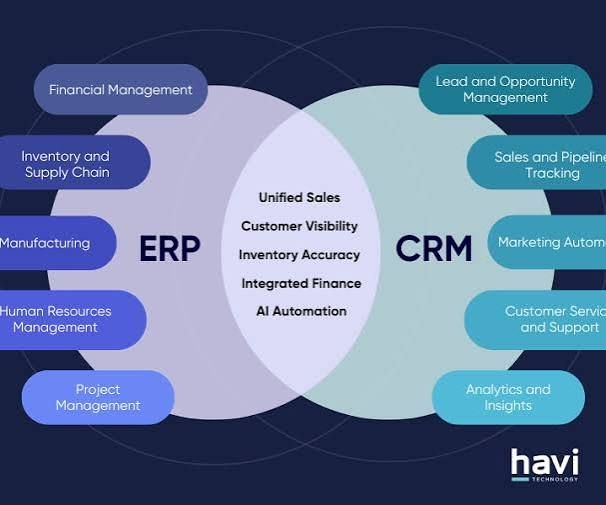

Many businesses use separate systems to manage customer relationships and internal operations. While a Customer Relationship Management (CRM) system handles sales, marketing, and customer interactions, an Enterprise Resource Planning (ERP) system manages finance, inventory, procurement, and business processes. When these systems operate independently, businesses often face duplicate data, communication gaps, and slower workflows.
Integrating CRM and ERP creates a connected business environment where information flows seamlessly across departments, improving productivity and decision-making.
What Is CRM and ERP Integration?
CRM and ERP integration connects customer-facing operations with internal business processes. Instead of maintaining separate databases, both systems share real-time information, allowing employees to access accurate data from one connected platform.
This integration helps businesses improve collaboration while reducing manual data entry.
Why Businesses Need Integrated Systems
As companies grow, disconnected software becomes difficult to manage. Sales teams may not have access to inventory information, while finance departments may struggle to track customer transactions efficiently.
An integrated solution eliminates these barriers and creates a unified workflow across the organization.
Benefits of CRM and ERP Integration
Improved Data Accuracy
Information entered into one system is automatically synchronized with the other, reducing duplicate records and manual errors.
Better Customer Service
Support and sales teams gain instant access to customer orders, invoices, service history, and communication records.
Faster Business Processes
Automated workflows reduce administrative work and allow departments to complete tasks more efficiently.
Enhanced Reporting
Business leaders receive comprehensive reports that combine customer, financial, and operational data for smarter decision-making.
Increased Productivity
Employees spend less time switching between systems and more time focusing on business growth.
Industries That Benefit from CRM and ERP Integration
Integrated business platforms are widely used in:
- Manufacturing
- Retail
- Healthcare
- Wholesale Distribution
- Financial Services
- Logistics
- Construction
- Information Technology
- Professional Services
- E-commerce
Organizations of all sizes can benefit from a connected business ecosystem.
Key Features of an Integrated Solution
A modern CRM and ERP integration typically includes:
- Customer data synchronization
- Sales pipeline management
- Inventory visibility
- Order processing
- Financial reporting
- Workflow automation
- Role-based access
- Real-time dashboards
- API connectivity
- Cloud deployment
These features improve operational efficiency while supporting business scalability.
Choosing the Right Development Partner
Successful integration requires careful planning and technical expertise. Businesses should work with experienced software developers who understand both CRM and ERP platforms and can build secure, scalable solutions.
Organizations planning to modernize their operations should invest in professional CRM development services that support seamless integration with ERP systems and other business applications.
Future of Integrated Business Systems
Artificial Intelligence, cloud computing, predictive analytics, and automation are making integrated business platforms even more powerful. Future CRM and ERP systems will provide deeper insights, automate complex workflows, and improve collaboration across every department.
Businesses adopting these technologies will be better equipped to adapt to changing customer expectations and market demands.
Conclusion
CRM and ERP integration helps businesses eliminate information silos, improve collaboration, and streamline daily operations. By connecting customer management with core business processes, organizations can increase efficiency, enhance customer service, and make better strategic decisions.
Investing in integrated business solutions creates a strong foundation for sustainable growth and long-term success.