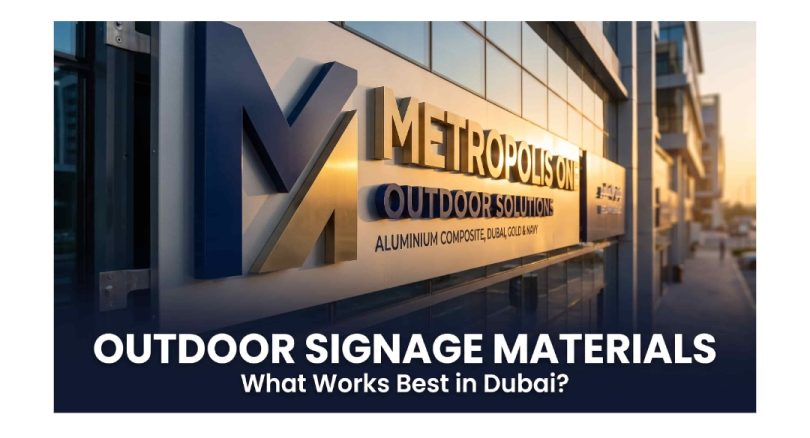

Dubai’s outdoor environment destroys signage materials that were not built for it. UV radiation, temperatures above 45°C in summer, sandstorm abrasion, and coastal humidity along the creek and marina districts — all of these work on a signage board every single day. A material that performs well in a European climate fails visibly in Dubai within 12 to 18 months.
The signage industry in Dubai has settled on a clear hierarchy of materials for outdoor use. Some are standard for almost every project. Others suit specific applications. Understanding which material suits which situation saves money. It also prevents replacing a board long before it should need replacing.
Why Material Choice Matters More in Dubai Than Almost Anywhere Else
Most signage industries globally deal with rain, frost, and moderate UV. Dubai deals with none of the first two and extreme levels of the third. The solar radiation intensity in the UAE is among the highest in the world. Surfaces without UV stabilization fade, chalk, and delaminate fast. Businesses used to milder climates are often surprised by the rate.
Furthermore, the temperature differential between day and night — and between summer and winter — creates thermal cycling in outdoor signage structures. Materials expand in the heat and contract at night. Over months of cycling, unstable materials develop warping, cracking, and fixing point stress. Both appearance and structural integrity suffer.
Any signage company in Dubai working at a professional standard accounts for both conditions from the outset.
The Main Materials Used for Outdoor Signage in Dubai
Aluminium Composite Panel — ACP
ACP is the most widely used material in Dubai’s outdoor signage market. It consists of two thin aluminium sheets bonded to a polyethylene core — giving it the rigidity of metal with a fraction of the weight. It is flat, dimensionally stable, easy to cut and route, and accepts print, vinyl graphics, and paint finishes cleanly.
For signage fabrication in Dubai, ACP is the standard substrate for flat fascia boards, building identification panels, and hoarding graphics. It handles thermal cycling without warping. The surface accepts UV-stable inks and vinyl that hold their colour for 5 to 7 years under direct Gulf sun. Furthermore, the aluminium face resists the surface abrasion from Dubai’s periodic sandstorms — which degrade softer substrates significantly faster.
The most important specification decision for ACP in Dubai is the surface coating. Polyester-coated ACP is adequate for covered or partially shaded positions. PVDF-coated ACP is the correct specification for fully exposed outdoor positions — the PVDF coating provides superior UV and chemical resistance that polyester cannot match over time.
Best for: fascia boards, building identification, hoarding panels, flat outdoor displays Typical lifespan in Dubai: 8 to 12 years with correct specification
Stainless Steel
Stainless steel is the premium material choice for outdoor signage fabrication in Dubai — used for dimensional lettering, building name plaques, and architectural signage elements on high-end commercial and residential developments.
Grade 316 stainless steel is the correct specification for outdoor use in Dubai’s coastal areas. Grade 304 — the more common and lower-cost option — is adequate for inland positions away from coastal humidity. Grade 316 contains molybdenum, which provides additional resistance to chloride corrosion in the salt-laden air along Dubai’s coastline.
Stainless steel dimensional letters communicate permanence and quality. They suit building name signs, hotel entrance signage, and corporate headquarters identification. Premium commercial districts across Dubai use them widely. Furthermore, stainless steel requires no surface coating maintenance — the material’s corrosion resistance is inherent rather than applied.
Best for: dimensional lettering, building name plaques, premium architectural signage Typical lifespan in Dubai: 15 to 25 years with correct grade specification
High Density Polyethylene — HDPE
HDPE sheet is a practical outdoor signage material used across Dubai’s construction, industrial, and temporary signage applications. It is fully waterproof, UV-stabilised, and resistant to the chemical exposure that construction site environments create.
Signage boards made from HDPE in Dubai typically serve construction hoardings, site identification boards, and temporary directional signage. The material cuts and routes easily. It accepts direct print and applied vinyl. It handles construction site abuse without cracking or delaminating.
HDPE is not the correct material for premium permanent signage in Dubai. Its surface texture and finish quality do not match ACP or metal for high-visibility brand applications. However, for cost-effective temporary and semi-permanent outdoor boards — it is reliable and practical.
Best for: construction site signage, temporary boards, industrial applications Typical lifespan in Dubai: 4 to 7 years in outdoor conditions
Acrylic — Cut and Cast
Acrylic is widely used in Dubai’s outdoor signage market for illuminated elements, lightbox faces, and channel letter backs. It transmits light evenly — making it the standard material for LED-illuminated signage fabrication across Dubai’s retail and hospitality sectors.
Cast acrylic outperforms extruded acrylic in Dubai’s outdoor conditions. Cast acrylic has better UV stability, lower thermal expansion, and greater consistency of thickness — all relevant in a climate that pushes thermal and UV performance limits. Extruded acrylic is more cost-effective but shows yellowing and surface crazing faster under Dubai’s sun intensity.
The limitation of acrylic as an outdoor material in Dubai is impact resistance. It is more brittle than aluminium or HDPE — a significant consideration for signage in positions exposed to vehicle proximity, maintenance access, or physical contact.
Best for: illuminated lightbox faces, LED channel letter backs, translucent display elements Typical lifespan in Dubai: 5 to 8 years for extruded, 8 to 12 years for cast acrylic
Vinyl Graphics on Rigid Substrates
Vinyl graphics applied to ACP, steel, or HDPE substrates carry the graphic content on most boards in Dubai. The substrate provides the structural element. The vinyl carries the brand identity.
Outdoor vinyl specification in Dubai matters significantly. Cast vinyl outperforms calendered vinyl in outdoor applications — it conforms better to surface irregularities, shrinks less under thermal cycling, and holds colour significantly longer under UV exposure. Cast vinyl rated for 7 to 10 years outdoor exposure is the standard for permanent boards in Dubai.
Furthermore, the overlaminate applied over the printed vinyl adds UV protection, scratch resistance, and surface sheen — all of which extend the graphic life of the board beyond what unlaminated vinyl achieves in Dubai’s conditions.
Best for: graphic content on all rigid outdoor signage substrates Typical lifespan in Dubai: 5 to 10 years for cast vinyl with UV overlaminate
Material Selection by Signage Board Type
| Signage Type | Recommended Material | Why |
|---|---|---|
| Fascia board | PVDF-coated ACP | Flat, stable, UV-resistant |
| Dimensional letters | Grade 316 stainless steel | Premium finish, corrosion-resistant |
| Illuminated lightbox | Cast acrylic face on ACP cabinet | Light transmission, UV stability |
| Construction hoarding | HDPE or ACP | Cost-effective, impact-resistant |
| Building name plaque | Stainless steel or solid aluminium | Permanence, premium appearance |
| Wayfinding panel | ACP with cast vinyl graphics | Durable, easily updated |
| Temporary site board | HDPE | Practical, weather-resistant |
What a Professional Signage Company in Dubai Specifies
The difference between a board that lasts and one that fails early is almost always a specification decision. It gets made before fabrication starts. A professional signage company in Dubai does not use the cheapest available material for every project. It matches the material to the position, the exposure level, and the expected lifespan. The brand standard the client needs to maintain also factors in.
Specifically, this means specifying PVDF-coated ACP rather than polyester-coated for fully exposed positions. It means grade 316 rather than 304 stainless steel within 500 metres of the coast. It means cast acrylic rather than extruded for illuminated elements that will be in continuous operation under Dubai’s sun. It also means cast vinyl with UV overlaminate rather than calendared vinyl. Any graphic that needs to hold colour for more than two years outdoors requires this.
These are not premium upgrades. They are correct specifications for the environment the board will face.