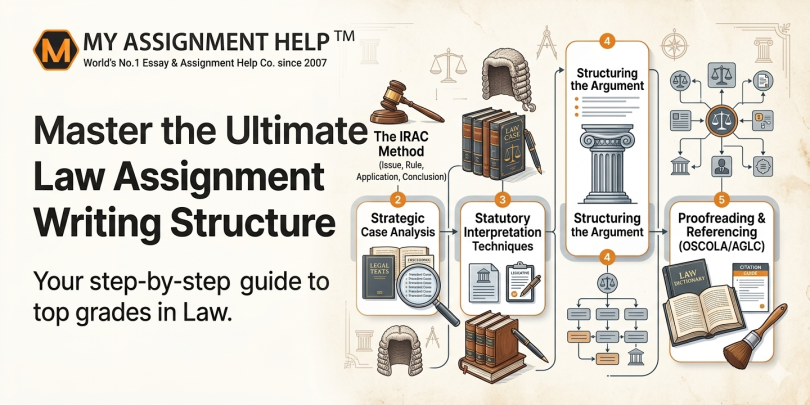

Navigating an undergraduate or postgraduate law degree within the Australian higher education ecosystem demands far more than an abstract familiarity with statutory instruments and judicial precedents. Whether analyzing an intricate problem question concerning state legislative powers under the Commonwealth Constitution or drafting a critical essay regarding civil liability frameworks, your academic performance depends fundamentally on architectural precision. The structural integrity of a legal assessment reflects your logical rigor; search engine frameworks and academic assessment rubrics alike look for clear indications of professional competence. In Australian law schools, content knowledge without formal structure inevitably leads to suboptimal marks, as clarity, sequence, and systematic reasoning form the baseline requirements of legal discourse.
The pedagogical shift in institutions such as the University of Sydney, Melbourne Law School, and the Australian National University heavily emphasizes the translation of abstract legal principles into practice-ready analytical competencies. When faced with complex statutory interpretations or conflicting common law principles, students regularly encounter intense structural hurdles. For instance, evaluating the structural validity of external affairs powers or institutional interferences requires a structured methodology that maps out constitutional limits meticulously. Students under severe time pressure frequently turn to professional constitutional law assignment help to clarify these high-stakes structural paradigms, ensuring their analytical narratives align explicitly with the institutional rubrics mandated by Australian legal faculties.
To systematically achieve first-class honors, academic papers must transcend generic structural arrangements found in standard humanities essays. Legal writing requires highly specialized, formulaic frameworks engineered to reflect the adversarial and evaluative realities of the Australian judicial system. Failing to implement these structures leads to fragmented arguments, unanchored case citations, and a failure to address the core legal issues raised within the brief. This guide provides an exhaustive breakdown of the architectural frameworks needed to master your coursework, ensuring your submissions demonstrate the high level of academic rigor required by search engines, institutional evaluators, and the legal profession.
1. Decoupling the Problem Question Structure: The Multi-Layered IRAC Matrix
The cornerstone of all practical legal assignments in Australia is the IRAC framework: Issue, Rule, Application, and Conclusion. While superficially straightforward, mastering this structure requires deploying it iteratively rather than flatly across a 2,500-word assignment. In complex problem scenarios containing multiple potential plaintiffs and defendants, a single, overarching IRAC structure fails. Instead, advanced students utilize a layered or nested IRAC approach, dedicating a discrete structural loop to every individual cause of action or legal issue identified.To visualize how this advanced nesting translates to a real-world legal fact scenario, review the structural architectural process map below:
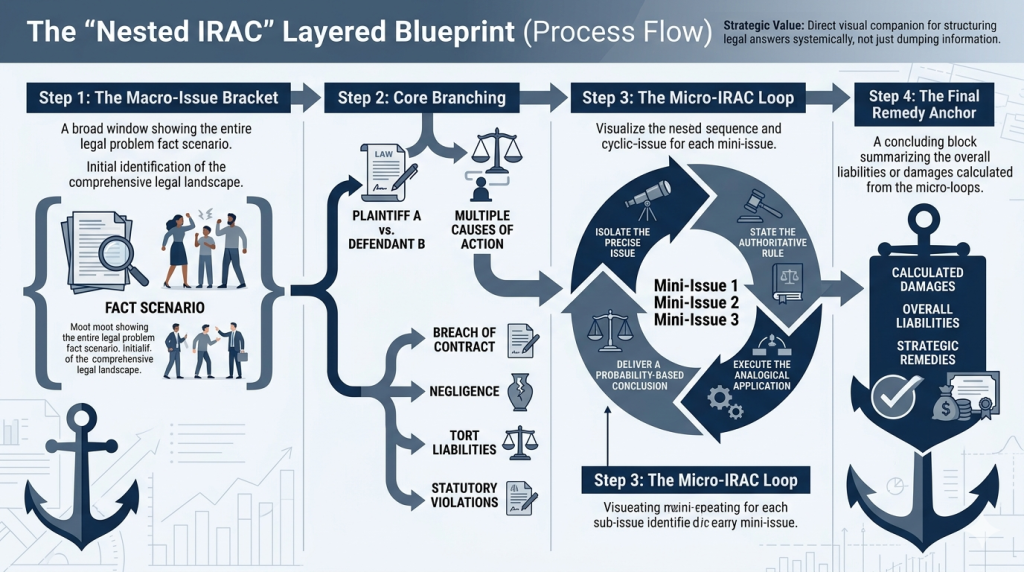
Logic-to-Landscape: The Deep Nested IRAC Process Map
The Issue (I): Pinpointing the Legal Controversy
Your opening statement must isolate the specific legal controversy with absolute precision. Avoid vague summaries of the fact scenario. Instead, frame the issue by directly connecting the material facts to the governing legal principle. For example:
“The issue is whether the defendant’s platform, by utilizing automated operational algorithms, breached the duty of care owed to the plaintiff under s 5B of the Civil Liability Act 2002 (NSW), thereby causing foreseeable economic loss.” This tells the examiner exactly what legal threshold is being tested.
The Rule (R): Synthesising Authority
The statement of the rule demands a synthesis of statutory provisions and authoritative judicial decisions. In Australia, the hierarchy of courts is absolute; High Court of Australia precedents override state-level appellate decisions. When setting out the rule, you must state the principle clearly, supported by proper citation. If multiple cases clarify a rule, order them chronologically or logically to show how the doctrine developed. Do not inject facts from your problem brief into this section; keep it entirely focused on established law.
The Application (A): The Engine of Your Assessment
The application phase is where the vast majority of your marks are secured. Here, you must apply the rules established in your previous section directly to the material facts of the problem question. The most common mistake made by law students is merely stating the facts alongside the law without showing how they connect.
You must use analogical reasoning: compare the facts of your problem brief to the facts of key binding precedents. If your case mirrors Donoghue v Stevenson, explicitly explain why; if it diverges from Commercial Bank of Australia Ltd v Amadio, highlight the factual distinctions that justify a different legal outcome.
The Conclusion (C): Providing a Definitive Resolution
A weak conclusion undermines an otherwise strong legal argument. Never state that a case “could go either way.” Judges cannot refuse to rule, and your marker expects a definitive conclusion based on a balance of probabilities. State clearly which party is likely to succeed and outline the specific remedies or liabilities that flow from that success, such as damages, injunctions, or statutory penalties.
2. Structural Blueprints for Law Essays and Critical Critiques
Unlike problem questions, legal essays require you to critically analyze law reform, evaluate systemic jurisprudence, or critique socio-legal dynamics. These require a linear, thematic architectural structure rather than an IRAC format. A high-scoring legal essay structure consists of three core components:
| Structural Element | Target Word Count % | Strategic Execution Directive |
| Introduction & Thesis | 10% – 15% | Establish the thematic context, outline the exact scope, and present a definitive, unambiguous thesis statement answering the prompt. |
| Thematic Body Paragraphs | 70% – 75% | Group arguments conceptually. Each paragraph must feature a clear topic sentence, deep analytical critique, and synthesis of academic literature. |
| Conclusion | 10% | Synthesise the insights developed without introducing new evidence, reinforcing the ultimate validity of your thesis. |
To successfully execute these thematic body sections, you must maintain a highly academic perspective. Relying on superficial summaries of case law or opinionated assertions will weaken your paper’s impact. Instead, each paragraph must be supported by empirical legal research, law reform commission reports (such as those from the Australian Law Reform Commission), and peer-reviewed journal articles.
When balancing intense research schedules alongside complex assignment layouts, accessing professional assignment writing help can provide students with foundational structural templates. This allows them to focus their energy on deep critical analysis rather than getting bogged down in basic formatting mechanics.
3. AGLC4 Citation Precision and Visual Proofing
In Australian legal education, academic integrity and precision are evaluated largely through your compliance with the Australian Guide to Legal Citation (4th edition). Minor errors in formatting, italics, or punctuation can lead to structural failures under faculty assessment guidelines. AGLC4 is not a superficial stylistic preference; it is a fundamental system of legal verification that establishes the authoritative basis of your arguments.
AGLC4 Structural Quick-Reference Rules
- Case Law: Mabo v Queensland [No 2] (1992) 175 CLR 1. Note the specific configuration of spaces, the lack of punctuation between reporter volumes, and the proper italicisation of party names.
- Statutory Instruments: Corporations Act 2001 (Cth) s 180. Jurisdictional abbreviations must be enclosed within parentheses, followed immediately by the precise section reference.
Furthermore, structural clarity can be enhanced by incorporating concise analytical summaries. When presenting comparative statutory provisions or mapping administrative frameworks, clear structural formatting allows markers to instantly assess your analytical depth. It prevents your core argument from getting buried under overly dense, unbroken blocks of narrative prose.
4. Common Structural Blindspots in Australian Legal Assessments
Even when using an IRAC structure, papers can lose marks due to specific structural blindspots common to undergraduate law assignments. First is the failure to clearly differentiate between federal and state jurisdictions. Conflating Commonwealth powers under the Constitution with state legislative powers under the Constitution Act 1902 (NSW) reveals a fundamental misunderstanding of Australia’s federal structure. Always establish the governing jurisdiction in your opening sentence before applying statutory provisions.
Second is the common mistake of presenting an argument without addressing potential counterarguments. Australian legal reasoning is inherently evaluative. Your structure must explicitly account for the opponent’s strongest arguments, showing why they are likely to fail based on established precedent or statutory interpretation. Dedicate a specific section within your application phase to address these potential defenses; this demonstrates a level of objective analysis that elevates your work from a standard credit to a high distinction.
Key Takeaways
- IRAC Matrix is Non-Negotiable: Every problem question must strictly follow the Issue, Rule, Application, and Conclusion sequence without deviation.
- AGLC4 Compliance: Precision in footnotes and bibliographies according to the Australian Guide to Legal Citation (4th ed) accounts for up to 10–20% of the overall rubric grading.
- Jurisdictional Specificity: Always distinguish clearly between Commonwealth legislation and state-based statutory frameworks (e.g., NSW Civil Liability Act vs. Victorian Wrongs Act).
- Structural Proportion: Allocate approximately 70% of your total word count to the ‘Application’ phase where deep critical analysis occurs.
5. Frequently Asked Questions (FAQs)
Q1: Can I use subheadings in an IRAC problem question assignment?
Yes. In Australian law faculties, subheadings are highly encouraged. They should be used to organize your paper by party name, specific cause of action, or individual legal issue. This keeps your structural progression transparent and easy to follow.
Q2: How do I handle multiple issues within a single fact scenario?
You should use a nested IRAC structure. Address each issue completely from Issue through to Conclusion before moving on to the next one. This prevents your analysis from becoming confusing and disorganized.
Q3: Is a separate bibliography required for an AGLC4-compliant assignment?
This depends on your specific faculty guidelines. However, standard AGLC4 conventions generally require a comprehensive bibliography divided into distinct sections: Articles/Books/Reports, Cases, Legislation, and Other Material.
Q4: What is the difference between an issue in a problem question and a thesis statement in an essay?
An issue identifies a specific legal question raised by a set of facts. A thesis statement presents a central argument that directly answers an essay prompt, taking a clear stance on a legal debate or theory.
About the Author
This comprehensive academic guide was prepared by a Mark William,Senior Content Strategist and Academic Consultant at MyAssignmentHelp. Holding an LLM from an elite Australian Group of Eight (Go8) university and with over nine years of experience in tertiary legal education, they specialize in helping students master complex legal research, AGLC4 compliance, and advanced analytical problem structures across Australian and international jurisdictions.
References and Authoritative Data Sources
- Australian Guide to Legal Citation (4th ed, 2018) Melbourne University Law Review Association.
- Law Council of Australia, ‘Legal Education and Training Performance Standards’ (Strategic Policy Report, 2024).
- Australian Law Reform Commission (ALRC), ‘Corporate Criminal Responsibility’ (Report No 136, April 2020).
- Judicial College of Victoria, ‘Statutory Interpretation Frameworks’ (Resource Guide, 2025)