
Organizations across the United States are increasingly rethinking how internal operations are designed as efficiency and scalability become critical to long-term growth.
Many businesses are investing in business process development to eliminate redundancies, improve coordination, and support faster decision-making across teams.
Recent industry data shows that around 60% of U.S. companies had already implemented automation in at least one business process by 2024, reflecting a clear shift toward structured, efficiency-driven operational models.
As competitive pressures intensify, developing well-defined, adaptable business processes is emerging as a core strategy for driving both operational efficiency and sustainable growth.
Aligning Business Processes With Strategic Objectives
Effective processes begin with a clear connection to organizational goals. Without strategic alignment, even well-documented workflows can fail to deliver measurable value or support long-term growth initiatives.
To ensure processes directly contribute to efficiency and growth, organizations focus on the following alignment practices:
- Clear definition of business objectives – Organizations begin by defining measurable goals related to cost control, customer experience, or scalability. Process design is then aligned to support these objectives, ensuring workflows deliver outcomes that directly contribute to strategic priorities.
- Identification of value-creating activities – Process mapping helps distinguish value-adding steps from redundant actions. Eliminating non-essential activities improves efficiency while preserving steps that directly impact customer or business value.
- Cross-functional stakeholder involvement – Involving leaders and teams from multiple departments ensures processes reflect real operational needs. Cross-functional input reduces silos and improves adoption across the organization.
- Prioritization of high-impact processes – Organizations focus first on processes that influence revenue, customer satisfaction, or operational risk. Targeting high-impact areas ensures optimization efforts deliver visible and meaningful results.
- Continuous alignment reviews – As strategies evolve, processes are revisited and adjusted. Regular reviews ensure workflows remain aligned with changing business goals and market conditions.
Strategic alignment ensures processes are not optimized in isolation but instead serve as direct enablers of organizational efficiency and long-term growth.
Designing Standardized and Scalable Process Frameworks
Standardization provides consistency, while scalability ensures processes can support growth without constant redesign. Together, these elements form the backbone of efficient operations.
To build scalable and standardized workflows, organizations adopt the following design principles:
- Documented process workflows – Clear documentation defines roles, responsibilities, and sequence of activities. This reduces ambiguity, improves training efficiency, and ensures consistency across teams and locations.
- Standard operating procedures (SOPs) – SOPs establish uniform execution standards. Consistent procedures minimize errors, improve quality, and enable smoother collaboration across departments.
- Modular process design – Modular workflows allow individual components to be adjusted without disrupting the entire process. This flexibility supports faster adaptation to change and growth.
- Clear ownership and accountability – Assigning process owners ensures accountability for performance and improvement. Ownership prevents process degradation over time.
- Built-in scalability considerations – Processes are designed to handle increased volume, users, or locations. Scalability reduces friction as organizations expand operations.
Standardized and scalable process frameworks enable consistent execution today while supporting efficient expansion tomorrow.
Using Data and Technology in Process Development
Modern efficiency depends on data visibility and intelligent automation. Technology plays a critical role in enhancing accuracy, speed, and adaptability within business process development initiatives.
To strengthen process performance, organizations integrate the following data-driven approaches:
- Process performance measurement – Key metrics such as cycle time, error rates, and throughput provide insight into efficiency. Data-driven measurement enables objective evaluation and targeted improvement.
- Workflow automation opportunities – Automating repetitive tasks reduces manual effort and errors. Automation also accelerates execution and frees teams to focus on higher-value activities.
- Real-time operational visibility – Dashboards and reporting tools provide real-time insight into process performance. Visibility enables faster decision-making and proactive issue resolution.
- Integration across systems – Connecting processes across finance, operations, and customer systems eliminates data silos. Integrated workflows improve accuracy and coordination.
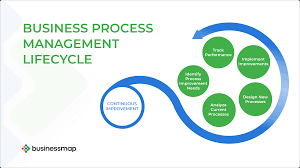
- Continuous data feedback loops – Performance data feeds into ongoing refinement. Continuous feedback supports incremental improvements rather than one-time optimization efforts.
Technology and data transform process design from static documentation into dynamic, continuously improving operational systems.
Building Process Ownership and Organizational Adoption
Even the best-designed processes fail without adoption. Organizational engagement and accountability are critical to ensuring process initiatives deliver real-world efficiency gains.
To strengthen adoption and accountability, organizations emphasize the following practices:
- Clear communication of process purpose – Teams understand why processes exist and how they support broader goals. Purpose-driven communication improves buy-in and compliance.
- Role-based training and enablement – Training tailored to specific roles improves confidence and execution quality. Well-trained teams adopt processes more consistently.
- Change management integration – Structured change management addresses resistance and uncertainty. This reduces friction during process transitions.
- Performance accountability mechanisms – Linking process adherence to performance metrics reinforces accountability. Accountability ensures processes are followed and improved.
- Feedback and improvement channels – Employees contribute insights based on daily use. Feedback loops strengthen ownership and practical relevance.
Strong ownership and adoption convert process design into sustained operational improvement and cultural alignment.
Driving Continuous Improvement and Long-Term Growth
Efficiency and growth depend on ongoing refinement rather than one-time optimization. Mature organizations treat business process development as an evolving capability.
To support continuous improvement, organizations focus on the following growth-oriented practices:
- Regular process performance reviews – Scheduled evaluations identify inefficiencies and improvement opportunities. Reviews ensure processes remain effective over time.
- Incremental optimization mindset – Small, consistent improvements deliver cumulative gains. Incremental change reduces disruption while improving performance.
- Scalability testing and stress analysis – Processes are tested against growth scenarios. This prepares organizations for expansion without operational breakdowns.
- Alignment with innovation initiatives – Process improvements support new products, services, and markets. Alignment ensures operational readiness for innovation.
- Long-term capability building – Developing internal expertise ensures sustainable improvement. Capability building reduces reliance on external interventions.
Continuous improvement embeds efficiency into organizational DNA, enabling sustainable growth and resilience.
Conclusion
Developing effective business processes is no longer a back-office exercise but a strategic imperative for organizations seeking efficiency and sustainable growth.
By aligning workflows with objectives, standardizing execution, leveraging technology, and fostering ownership, businesses can transform operations into scalable and resilient systems.
Continuous improvement ensures processes evolve alongside market demands and organizational growth. As digital platforms continue to shape how processes are designed and managed, firms like Zoho demonstrate how flexible, configurable solutions can support modern process development initiatives.
Businesses that invest in thoughtful process design today are better positioned to operate efficiently, adapt quickly, and grow confidently in an increasingly competitive environment.